

Over the past fifty years, the Great Burn Conservation Alliance (GBCA) has helped develop and shepherd 16 congressional bills advocating for the protection of the recommended Great Burn Wilderness. We’ve influenced the adoption of positive conservation language in forest management and travel management plans for both forests in our Mission Area — some of the most progressive in the nation.
THE GREAT BURN’S
WILD LEGACY
-
The GBCA advocates for strong administrative policies that protect the Great Burn wildlife and wild lands within our Mission Area.
Currently, we are focused on influencing strong conservation outcomes in forest plan revisions on the Lolo National Forest.
We also regularly participate in planning and comment periods for forest projects in our area to ensure that the region’s wildlife and roadless areas are safeguarded.
-
Our policy work isn’t complete until the Great Burn and Mallard Larkins are permanently protected as designated Wilderness for future generations.
Together with our coalition partners, the GBCA works to build a broad coalition of support for Wilderness through:
Participation in collaborative groups
Grassroots organizing in the Great Burn’s gateway communities
Regular interaction with staff from the Idaho and Montana congressional delegations
WHAT WE’RE WORKING TOWARDS
FOREST MANAGEMENT IN THE LOLO NATIONAL FOREST
WHAT’S HAPPENING
The Lolo National Forest is about a third of the way through the multi-year forest planning process. The Forest Service released its Proposed Action on January 31, 2024, and is planning to release a Draft Environmental Impact Statement in late summer/early fall 2026.
WHAT WE’RE ADVOCATING FOR
1. Maintain the existing Hoodoo (Great Burn) Recommended Wilderness boundaries. In the Proposed Action, the Lolo National Forest has maintained the existing boundaries for the Great Burn recommended Wilderness, which is a great thing!
2. Recommend the Ward-Eagle and Upper North Fork-Meadowcreek inventoried roadless areas as Wilderness. Currently, these areas are classified as non-motorized backcountry. But we believe they deserve “recommended” wilderness status for their outstanding Wilderness characteristics and wildlife habitat value.
3. Prioritize wildlife habitat connectivity and corridor areas. The entire stateline area is key for large landscape connectivity, as well as more local elevational connectivity.
4. No non-conforming uses in recommended Wilderness areas. By maintaining no mechanized or motorized use in recommended wilderness areas, we can ensure these areas remain eligible for permanent protection in the future.
WHY IT MATTERS
The Lolo’s forest plan revision will direct management of the land for a generation. An effective plan ensures that vulnerable species (mountain goats, bull trout, white bark pine, wolverines, and grizzly bears) are protected and the Great Burn remains Wild.
HOW YOU CAN HELP
1. Stay informed: The Lolo National Forest hosted several engagement events this year where the public could learn more about the planning process. These events are informational and offer opportunities to submit public comments. You can subscribe to receive revision updates from the US Forest Service directly.
2. Subscribe to our newsletter: The GBCA periodically hosts webinars and events about the Lolo National Forest. Signing up for our newsletters means you’ll be among the first to learn about educational opportunities and what we’re doing during the revision planning process.
3. Submit a public comment: The current comment period for the Lolo revision plan is closed. But there are more ways to submit comments.
FOREST MANAGEMENT IN THE NEZ PERCE-CLEARWATER NATIONAL FOREST
WHY IT MATTERS
The Nez Perce-Clearwater National Forest manages the majority of the Idaho portion of GBCA’s Mission Area. This includes 12 roadless areas and 179,600 acres of recommended wilderness (Hoodoo and Mallard Larkins).
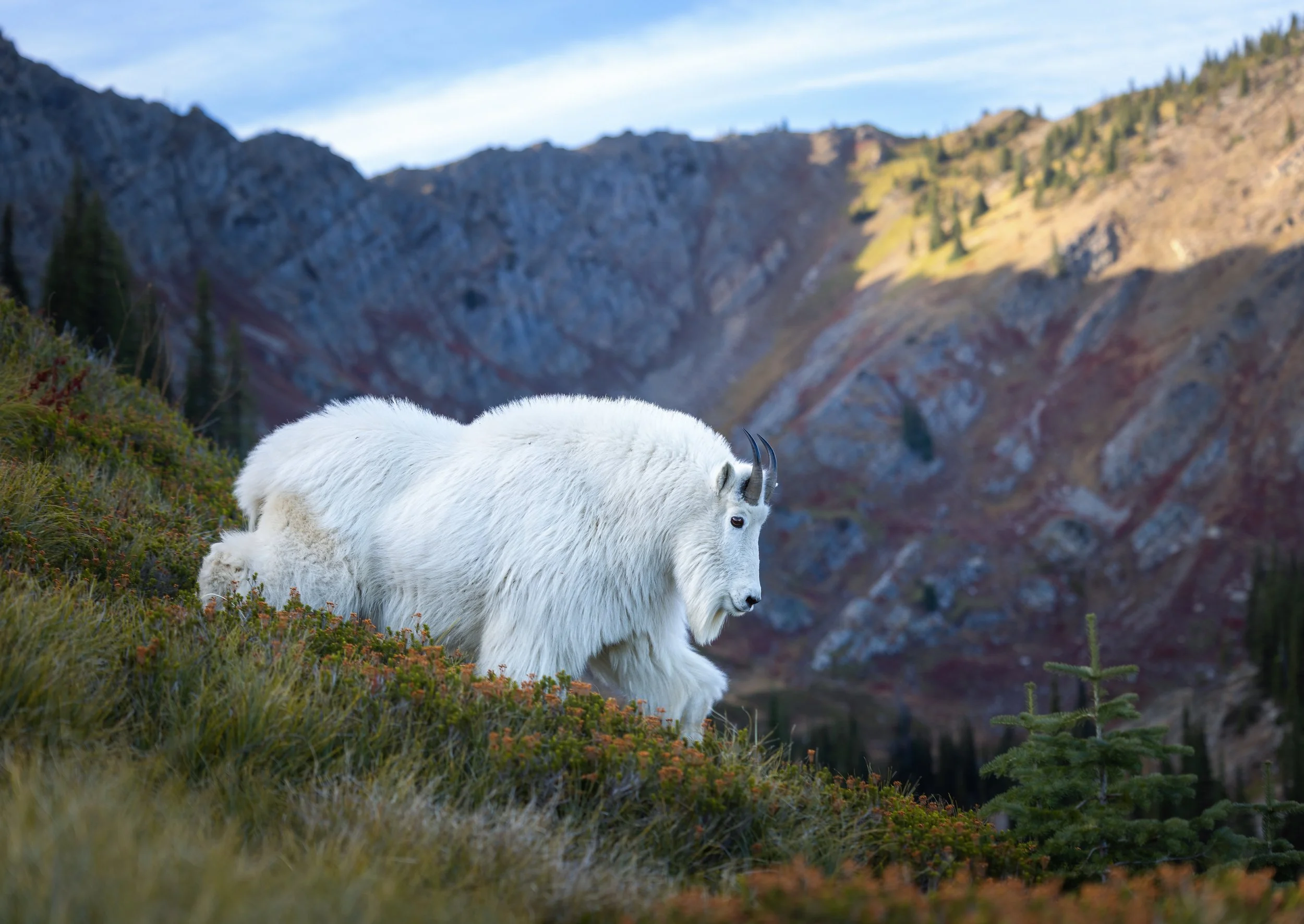
Unfortunately, the plan drastically reduced protections for one of the wildest and most untrammeled areas in the Northern Bitterroot Mountains. It removed recommended wilderness protections from the area north of Fish Lake, the stateline trail, as well as the area around Goat Lake and Blacklead Mountain. This area is a key habitat for wolverines, mountain goats, and an expanding grizzly population.
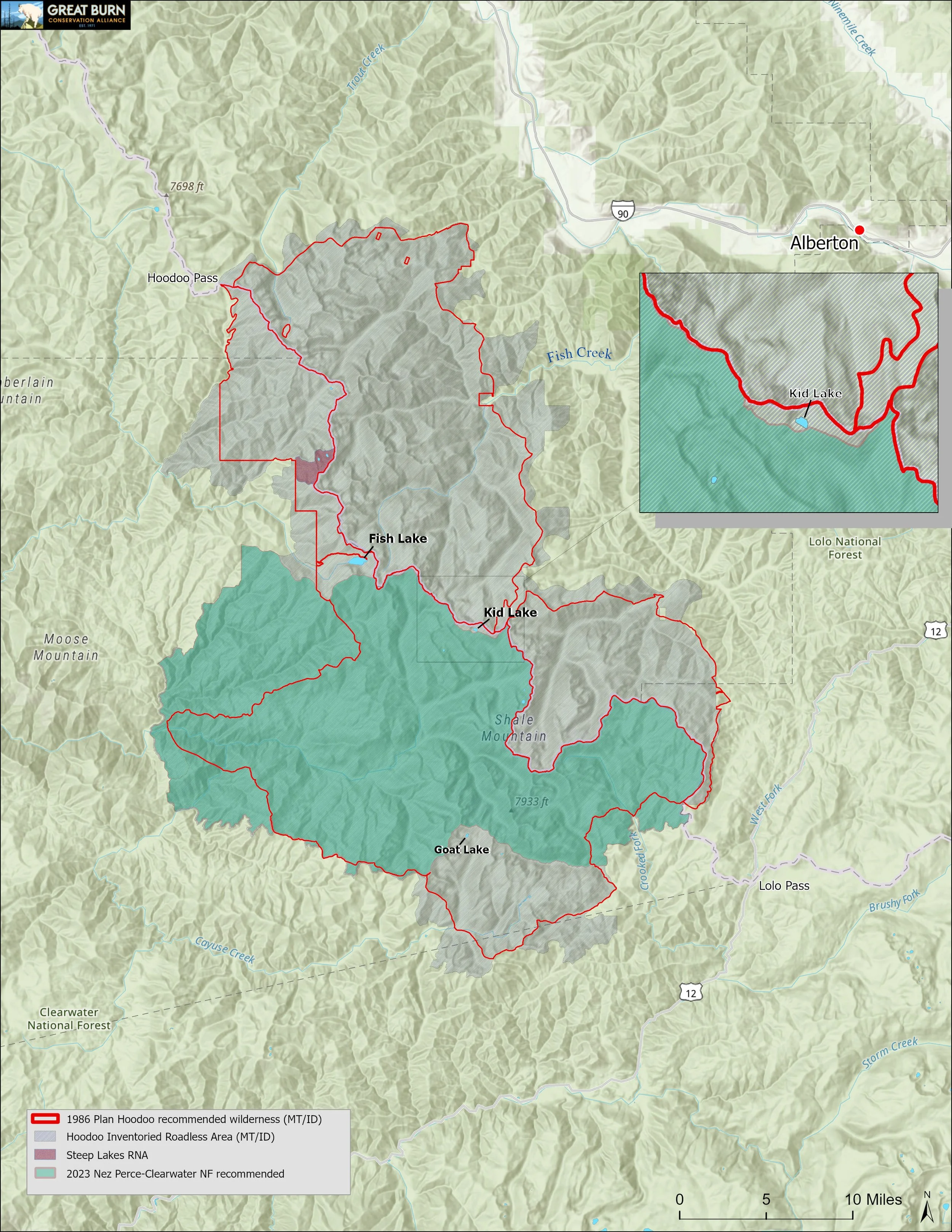
The parts of our Mission Area affected by the Nez Perce-Clearwater National Forest plan.
WHAT’S HAPPENING
The Nez Perce-Clearwater National Forest signed the final ROD on January 10, 2025, and the plan took effect in February 2026. There are no public involvement opportunities at the moment.
GRIZZLY BEAR PROTECTIONS IN RECOVERY ZONES
WHAT’S HAPPENING
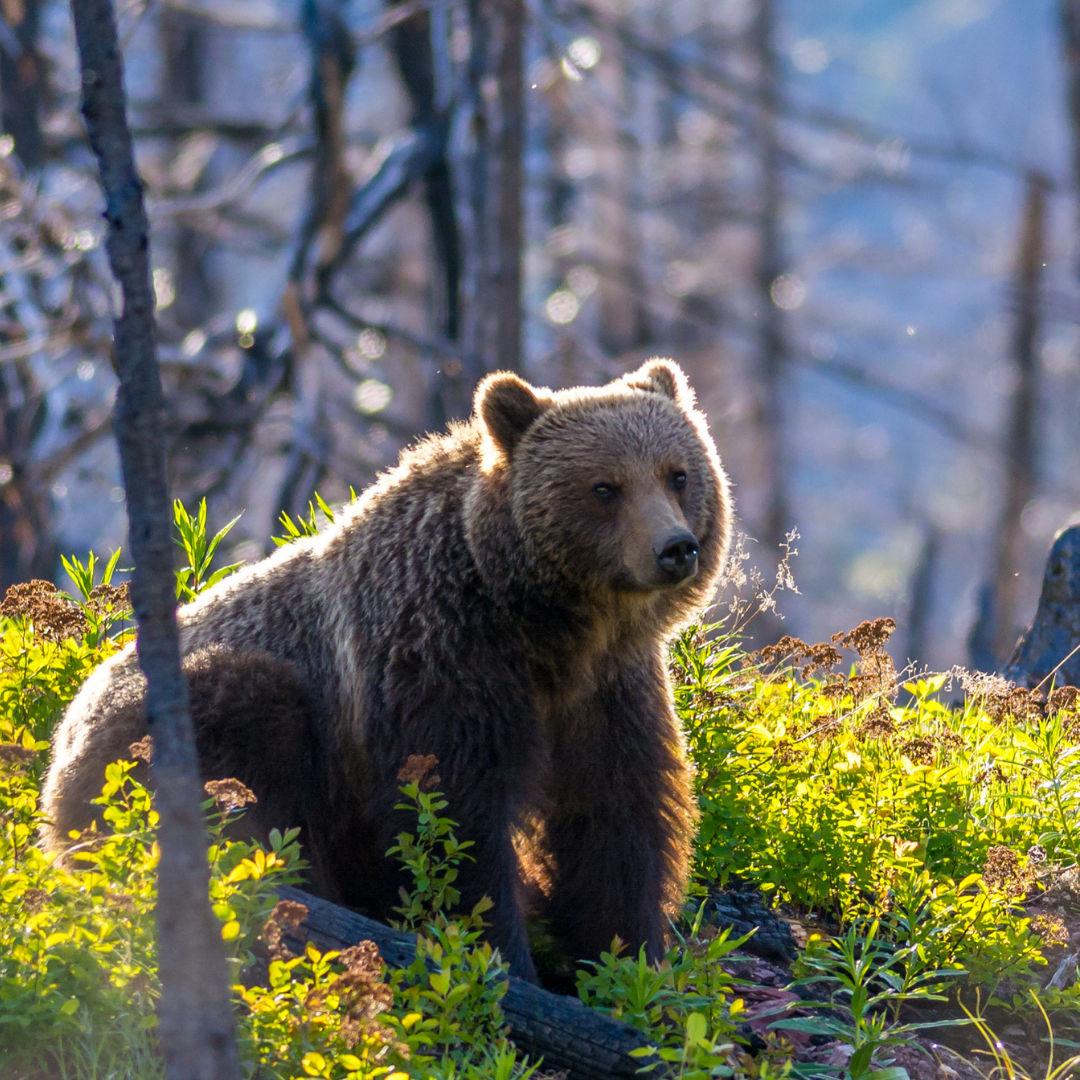
The Bitterroot ecosystem is one of the six identified grizzly bear recovery zones in the lower 48 states. Although individual grizzly bears have been documented in the Bitterroot Ecosystem, no established population currently exists in this recovery zone.
In January 2025, the US Fish and Wildlife Service (USFWS) announced a proposed update to grizzly bear Endangered Species Act Listing and Management, maintaining Endangered Species Act (ESA) protections for grizzlies in the lower 48 states.
The proposed action responded to petitions by Montana and Wyoming to delist current populations in the Greater Yellowstone and North Continental Divide Ecosystems. This revision established a single distinct population segment (DPS) of grizzlies, which would retain threatened status under the ESA.
This update aligned with current research, which documented grizzlies moving between the current recovery zones, indicating that those populations were no longer discrete and had developed into a single population covering a larger area.
The USFWS determined that delisting the populations is “not warranted,” but the House Natural Resources Committee voted to delist the Greater Yellowstone Grizzly Population.
WHY IT MATTERS
Overall, this was a step forward for the species and highlights the continued need for habitat protection to support grizzly movement, connectivity, and long-term recovery.
Unfortunately, in conjunction with the delisting, the proposal removed ESA protections outside of the new DPS, significantly diminishing the areas where grizzly bears are protected, and included increased flexibility for management agencies and authorized landowners to eliminate grizzly bears involved in conflicts.
HOW YOU CAN HELP
The best way to get involved is to contact your senators and representatives regarding grizzly bear protections. Here’s how you can communicate your support:
1. Tell them you care about grizzly bears: It's important to stress why you value grizzlies as a keystone species, especially if you frequently share the landscape with these iconic mammals.
2. Show your support for maintaining threatened status for all grizzly bears in the lower 48: Continued federal protections are the best way to ensure the long-term viability of the species in the Northern Rockies.
3. Express agreement with the USFWS's assessment that delisting was not warranted: At the end of the day, the best science and the agency tasked with managing grizzlies indicated that delisting would not benefit the species.
MAINTAINING ROADLESS RULES IN MONTANA
WHAT’S HAPPENING
Currently, Inventoried Roadless Areas (IRAs) are managed by the 2001 Roadless Rule that protects 58.5 million acres of undeveloped national forest lands from new road construction and logging. In the Great Burn ecosystem, 27 Roadless areas make up 1.3 million acres. These areas make up the ecological backbone of the region, serving as migration corridors for grizzlies, Canada lynx, bull trout, wolverines, and a host of other vulnerable species.
In June 2025, the United States Department of Agriculture (USDA) announced its intent to rescind the Roadless Rule. As of now, this is only a proposal. In August 2025, the notice of intent to prepare an environmental impact statement to evaluate the effects of the proposed rulemaking was published in the Federal Register, according to the USFS.
To actually rescind the rule, a formal reverse rulemaking process will be required, including public notice, public comment periods (hopefully), environmental review, and likely litigation. This change will have a huge impact on conservation throughout most of the United States. However, a few states, including Idaho, have their own versions of the Roadless Rule that will not be affected by the change.
WHY IT MATTERS
Rescinding the Roadless Rule would put some of the nation’s most wild, intact, and ecologically vital lands at risk and potentially harm the larger integrity of the Great Burn ecosystem.
Rescinding the 2001 Rule would only affect the Great Burn’s 229,000 Racres of roadless areas in Montana. But the GBCA anticipates that pressure will build for Idaho to follow the federal government and revise or rescind its rule.
Protecting Roadless Areas would mean preserving scenic backdrops and living systems that store carbon, filter drinking water, and protect biodiversity. Much of our clean water starts in roadless areas. Their ecological, cultural, and recreational value is immense.
HOW YOU CAN HELP
The best way to get involved is to contact your senators and representatives regarding grizzly bear protections. Here’s how you can communicate your support:
1. Tell them you care about grizzly bears: It's important to stress why you value grizzlies as a keystone species, especially if you frequently share the landscape with these iconic mammals.
2. Show your support for maintaining threatened status for all grizzly bears in the lower 48: Continued federal protections are the best way to ensure the long-term viability of the species in the Northern Rockies.
3. Express agreement with the USFWS's assessment that delisting was not warranted: At the end of the day, the best science and the agency tasked with managing grizzlies indicated that delisting would not benefit the species.
MORE WAYS TO GET INVOLVED
VOLUNTEER
Continued staffing strains on the US Forest Service and loss of key personnel pose a significant challenge to an already deep backlog of projects. As a USFS partner, we tackle essential maintenance and clean-up projects. Volunteering to join us on a project can help you explore new parts of the Burn and make a difference to its continued care and upkeep.
ADVOCATE FOR THE BURN
Great Burn advocates play an essential role in helping shape awareness and public perception around our Mission Area. Advocates submit comments and speak up to land management agencies regarding plans, projects, or permanent protection decisions in the Great Burn and Mallard Larkins landscapes.
Throughout the forest planning or revision process, the public has opportunities to submit comments to the US Forest Service in support of or opposition to an issue. Outside of planning processes, you can share your support with elected officials regarding proposed or enacted legislation that affects the burn.
In neither case do you need to submit pages of letters to have your voice and opinions heard. A short email, letter, or voicemail will suffice.
The most important message you can communicate is why you love the Great Burn or feel the way you do. And it helps if you can summarize your thoughts in themes to help the recipient identify common patterns and points of disagreement.
You can also follow this basic structure for your comment:
Draft a polite greeting.
Introduce yourself and the issue you’re concerned about.
Share your point of view and reasons why you’re concerned.
Draft a clear call to action. This is what you want your recipient to do as a result of your comment.
Close with reminders of any upcoming deadlines or important dates and a summary of your concern.
Submitting a comment to the US Forest Service (USFS) is easy through its online comment database, the Comment Analysis and Response Application (CARA), when comment periods are open.
You can also submit comments via email through the agency’s Revision Inbox or by mail. You can send comments regarding the Great Burn Mission Area to the following:
HOW TO SUBMIT A COMMENT IN SUPPORT OF THE BURN

SEND COMMENTS TO THE FOLLOWING:
Lolo National Forest Supervisor’s Office
Attn: Lolo Plan Revision Team
24 Fort Missoula Road
Missoula, MT 59804
Nez Perce-Clearwater National Forest Supervisor’s Office
1008 Highway 64
Kamiah, ID 83536
FAQS
-
A forest plan is a land management plan that sets the direction and priorities for land use and resource development on a forest-wide scale. Forest plans don’t direct site-specific or local projects, such as how to manage an individual trail. Instead, they set the parameters for how projects within a forest are managed for the entirety of the time the plan is in effect.
National forests must revise their plans every 15 years, but that doesn’t always happen. The Lolo National Forest plan hasn’t been updated since 1986, meaning forest plans can have a significant impact for decades.
-
Forest plans set the tone for a generation of forest and land use for preservation, recreation, research, and industry. Creating and revising these plans — usually by teams of USFS employees working with tribal leaders, local governments, and other stakeholders — takes years of deliberation and public comment consideration.
Over the course of the planning process, planning officials follow five general steps:
1. A notice to start a forest assessment is issued. As part of that assessment, officials engage with the public and potential cooperating agencies and tribes, and identify existing conditions and trends on the land.
2. A notice to start plan development is issued. At this stage, officials will develop a proposed plan, outlining the need for change. Then, they’ll issue a notice of intent to prepare an Environmental Impact Statement (EIS) in accordance with the National Environmental Policy Act (NEPA).
The EIS identifies significant issues and alternative solutions, and describes the affected environment and environmental impacts. Once complete, the planning committee drafts its plan.
3. A notice of availability and 90-day public comment period is issued. At this point, the plan and the EIS are finalized.
4. A notice to start the objections process is filed. At this time, the committee reviews official responses to plan objections. A final plan is developed based on major objections.
5. A notice of plan approval is filed. At this point, the plan is implemented and monitored.
FORESTS
-
According to the Wilderness Act of 1964, “a wilderness, in contrast with those areas where man and his own works dominate the landscape, is hereby recognized as an area where the earth and its community of life are untrammeled by man, where man himself is a visitor who does not remain …
An area of wilderness is further defined to mean in this Act an area of undeveloped Federal land retaining its primeval character and influence, without permanent improvements or human habitation, which is protected and managed so as to preserve its natural conditions…”.
-
In any given federal land management plan, there are designations or management areas for recreation, industries like timber, and Wilderness. A Wilderness designation, granted by Congress, awards an area the highest level of land protection from commercial enterprises and timber harvesting, among other activities.
A designation for the Mallard Larkins and Great Burn recommended wilderness areas would:
Serve as wildlife habitats and havens for threatened species
Filter and clean the air we breathe
Protect the watershed and provide clean drinking water to communities
Boost nearby economies with tourism and recreation dollars
Provide outstanding places to recreate and to escape the bustle of the modern world
Maintain natural laboratories for education and scientific study, and historical and cultural artifacts
Over the years, administrative policies and some land management plans have put large swaths of the Great Burn ecosystem at risk of roadbuilding, mining, and logging, making our work all the more urgent.
WILDERNESS
GREAT BURN QUESTIONS
-
Do you care about a particular trail? A specific river? What recreation uses are allowed in certain areas? All are great reasons to submit public comments to the US Forest Service or reach out to your elected officials.
Rest assured that you don’t have to write a long letter or a dissertation to let your voice and opinions be heard. The most important message you can communicate is why you love the Great Burn or feel the way you do. And it helps if you can summarize your thoughts in themes to help the recipient identify common patterns and points of disagreement.
You can also follow this basic structure for your comment:
Draft a polite greeting.
Introduce yourself and the issue you’re concerned about.
Share your point of view and reasons why you’re concerned.
Draft a clear call to action. This is what you want your recipient to do as a result of your comment.
Close with reminders of any upcoming deadlines or important dates and a summary of your concern.
Submitting a comment to the US Forest Service (USFS) is easy through its online comment database, the Comment Analysis and Response Application (CARA), when comment periods are open.
You can also submit comments via email through the agency’s Revision Inbox or by mail. You can send comments regarding the Great Burn Mission Area to the following:
Lolo National Forest Supervisor’s Office
Attn: Lolo Plan Revision Team
24 Fort Missoula Road
Missoula, MT 59804Nez Perce-Clearwater National Forest Supervisor’s Office
1008 Highway 64
Kamiah, ID 83536In each of those cases, the USFS asks the public to refrain from using italic, bold, highlighted, or underlined text, which aren’t translated when the agency uploads comments to its database.
-
The US Forest Service (USFS) is the Great Burn’s land manager. The Lolo National Forest manages the Montana portion of our Mission Area, and the Nez Perce Clearwater and Idaho Panhandle National Forests manage the Idaho portion.
It’s not uncommon for our donors, visitors, and friends to think that the GBCA manages the Great Burn. But we are merely its caretakers and advocates. Our stewardship and volunteer work support the land, in partnership with the USFS and other federal, state, and nonprofit organizations.
Unfortunately, reductions in key USFS personnel have posed a serious challenge. When staffing is reduced, essential projects like bridge repairs, drainage maintenance, and long-term habitat improvement projects are delayed — or even abandoned. This puts public safety at risk and places greater strain on partner groups, like the GBCA, trying to pick up the slack.
BECOME A FRIEND OF THE BURN
Make any recurring donation, and opt in to receive action alerts, volunteer information, newsletters, and other opportunities to get engaged to become a Friend of the Burn. You’ll join hundreds of others who are showing support for permanent protection of this special place, so that it can stay Wild and available for generations to come.
